The slings and arrows of concern maintain flying at Fb. At this time a coalition of kid well being advocates has printed an open letter addressing CEO Mark Zuckerberg and calling for the corporate to shutter Messenger Children: Aka the Snapchat-ish comms app it launched within the US final December — focused on the below 13s.
At the time Fb described Messenger Kids as an “simpler and safer method” for youngsters to video chat and message with household and pals “once they can’t be collectively in particular person” — and stated the product had been “co-developed with dad and mom, youngsters and consultants”.
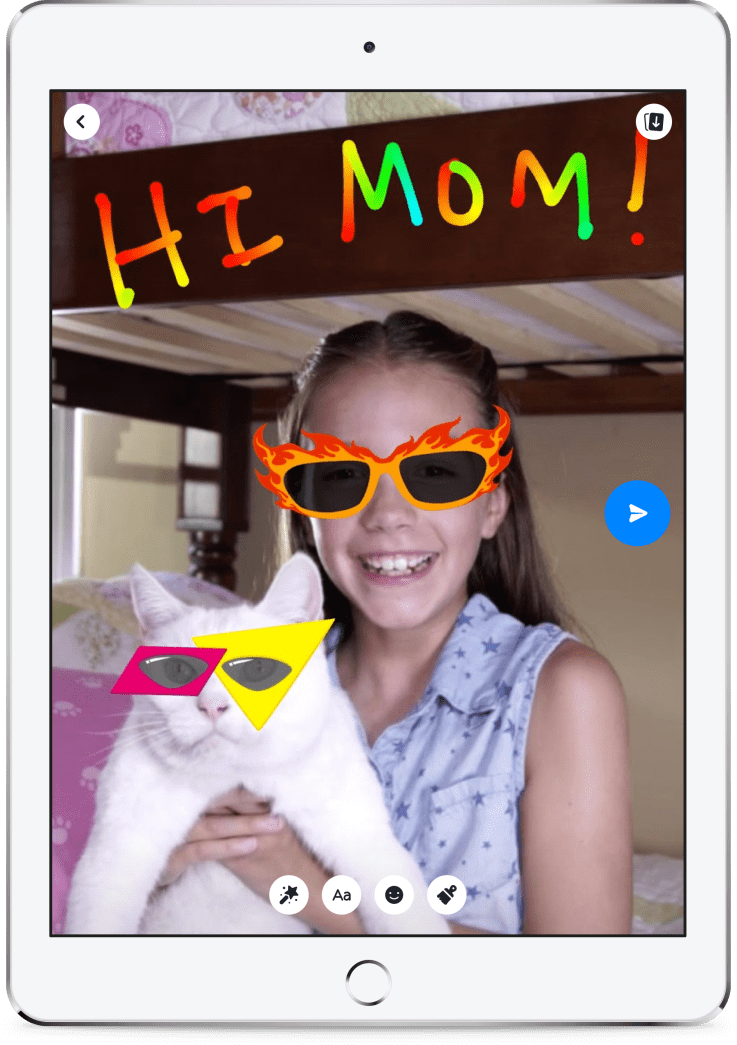
The video chat and messaging app features a child-friendly collection of augmented actuality lenses, emoji, stickers and manually curated GIFs for spicing up household messaging.
At launch Fb additionally emphasised there have been “no advertisements” or paid content material downloads contained in the app, and likewise claimed: “Your little one’s data isn’t used for advertisements.”
Although that individual message coming from a people-profiling advert large whose enterprise mannequin totally will depend on encouraging utilization of its merchandise so as to harvest consumer knowledge for advert concentrating on functions can solely maintain a lot water. And the corporate has been accused of attempting to make use of Messenger Children as, primarily, a ‘gateway drug’ to familiarize preschoolers with its merchandise — to have a greater probability of onboarding them into its ad-targeting mainstream product once they develop into youngsters.
A examine carried out by UK media watchdog Ofcom last fall has steered that use of social media by youngsters youthful than 13 is on the rise — regardless of social networks usually having an age restrict of 13-years-old for signups. (Within the EU, the incoming GDPR introduces a 13-years age-limit on youngsters having the ability to consent to make use of social media themselves, although Member States can select to lift the restrict to 16 years.)
In follow there’s little to cease youngsters who've entry to a cellular gadget downloading and signing up for apps and providers themselves — except their dad and mom are actively policing their gadget use. (Fb says it closes the accounts of any underage Fb customers when it’s made conscious of them.) And concern in regards to the impression of social media pressures on youngsters has been rising.
Earlier this month, for instance, the UK authorities’s Youngsters’s Commissioner for England known as for folks to ban their youngsters from utilizing the Snapchat messaging app — citing issues over addictive options and cyber bullying.
With Messenger Children Fb could be spying a possibility to attempt to outmanoeuvre its teen-focused rival by profitable over dad and mom with a devoted app that bakes in parental controls.
Nonetheless this technique of providing a sandboxed surroundings for teenagers to message with parentally accepted contacts isn’t profitable over everybody.
Spearheading a marketing campaign towards Fb Messenger Children, Boston-based not-for-profit the Campaign for a Commercial-Free Childhood has gathered collectively a coalition of round 100 little one well being advocates and teams to signal its open letter. It’s additionally operating a public petition — below the slogan ‘no Fb for 5 yr olds’.
Within the letter the group describes it as “significantly irresponsible” of Fb to have launched an app concentrating on preschoolers at a time once they say there's “mounting concern about how social media use impacts adolescents’ wellbeing”.
Last week, for instance, a examine carried out by researchers at San Diego State College discovered that teenagers who spent extra time on social media, gaming, texting and video-chatting on their telephones weren't as completely happy as those that performed sports activities, went outdoors and interacted with folks head to head.
“Youthful youngsters are merely not able to have social media accounts,” the coalition argues within the letter. “They don't seem to be sufficiently old to navigate the complexities of on-line relationships, which regularly result in misunderstandings and conflicts even amongst extra mature customers. In addition they shouldn't have a completely developed understanding of privateness, together with what’s applicable to share with others and who has entry to their conversations, photos, and movies.”
In addition they argue that Fb’s Messenger Children app is prone to lead to younger youngsters spending extra time utilizing digital units.
“Already, adolescents report problem moderating their very own social media use,” they write. “Messenger Children will exacerbate this drawback, because the anticipation of pals’ responses shall be a strong incentive for youngsters to test – and keep on – a cellphone or pill.
“Encouraging youngsters to maneuver their friendships on-line will intrude with and displace the face-to-face interactions and play which are essential for constructing wholesome developmental expertise, together with the flexibility to learn human emotion, delay gratification, and have interaction with the bodily world.”
The group goes on to rebut Fb’s claims that Messenger Children helps brings distant households nearer — by declaring that a devoted Fb app just isn't mandatory for youngsters to communicate with lengthy distance relations, and citing the plethora of other choices that can be utilized for that (comparable to utilizing a dad and mom’ Fb or Skype account or Apple’s FaceTime or simply making an quaint phone name) which don't require youngsters to have their very own account on any app.
“[T]he app’s total impression on households and society is prone to be damaging, normalizing social media use amongst younger youngsters and creating peer strain for teenagers to enroll in their first account,” they argue, including: “Elevating youngsters in our new digital age is troublesome sufficient. We ask that you don't use Fb’s monumental attain and affect to make it even more durable. Please make a robust assertion that Fb is dedicated to the wellbeing of kids and society by pulling the plug on Messenger Children.”
Requested for a response to the group’s name to shut down Messenger Children, a Fb spokesperson despatched us the next e mail assertion — reiterating its messaging across the product on the time it launched:
Messenger Children is a messaging app that helps dad and mom and youngsters to speak in a safer method, with dad and mom all the time accountable for their little one’s contacts and interactions. Since we launched in December we’ve heard from dad and mom across the nation that Messenger Children has helped them keep in contact with their youngsters and has enabled their youngsters to remain in contact with relations close to and much. For instance, we’ve heard tales of oldsters working night time shifts having the ability learn bedtime tales to their youngsters, and mums who journey for work getting every day updates from their youngsters whereas they’re away. We labored to create Messenger Children with an advisory committee of parenting and developmental consultants, in addition to with households themselves and in partnership with the PTA. We proceed to be targeted on making Messenger Children be the very best expertise it may be for households. We've been very clear that there isn't any promoting in Messenger Children.
Discussing what proof there's to assist issues over the event impression of digital units on preschool youngsters, John Oates, a senior lecturer in developmental psychology on the Open College who makes a speciality of early childhood, advised us: “The issue is that we've very excessive profile anecdotal instances [of social media concern, where the specific risk is tiny vs the total volume of chats being sent]… However, clearly the hurt is doubtlessly nice — and the true subject is balancing dangers and hurt.”
“There's little or no massive scale proof round precise developmental impacts on youngsters. And I feel that’s an issue — and it’s troublesome to know fairly how one would analysis that anyway. In, to isolate trigger and impact on this space is de facto, actually troublesome. As a result of youngsters differentially entry and use these social media due to their differing profiles — let’s name them character profiles.
“So some youngsters usually tend to be drawn to make use of social media after which a few of these youngsters are extra doubtless to make use of it in damaging methods, after which a few of these youngsters usually tend to be then uncovered, in consequence, to danger. So the trigger and impact chain that’s concerned may be very advanced.”
Oates additionally factors out that youthful youngsters, within the 6 to 12 years age vary which Fb Messenger Children targets, are firstly not essentially conscious of the dangers and potential harms, and secondly are additionally “not cognitively properly in a position to analyze, rationally, the dangers and make risk-free selections”.
“So I feel there's a problem round all social media by way of youngsters gaining access to it once they’re not conscious of the dangers. Whether or not they could possibly be educated higher or not is a troublesome query — as a result of in the event that they’re not cognitively in a position to make rational, risk-based judgements… it could possibly be argued that it doesn't matter what dad and mom do, and it doesn't matter what schooling does… that is nonetheless dangerous for youngsters,” he stated.
The opposite subject he raises as being some extent of dialogue and concern for little one psychologists is the extent to which in depth use of social media may be an issue by taking youngsters away from different actions which may be extra precious.
“There's a concern there, however there once more it comes again to what variations in youngsters predisposed them to get very concerned in Snapchat and different social media, Fb, and many others,” he advised TechCrunch. “And plainly one of many most important motivations for youngsters is a social one, to really feel that they're a part of a social group that they'll determine with.
“We all know that youngsters on this age vary are very delicate to see approval and peer disapproval. So that they’re usually fairly conscious of damaging messaging on social media — even when they haven’t skilled it, they’ll learn about it. As a result of that is very salient to them. So it’s actually the character of their social nexus that they kind that’s in all probability the formative component and the messaging inside that.”
“It's a actual problem to unpick trigger and impact on this space,” he added. “That’s why answering these questions… is extraordinarily troublesome. However I feel what we are able to do, alternatively, is we are able to draw tentative conclusions from what we do learn about youngsters’s improvement [such as the strong influence of peers].”
Oates additionally raises the potential of apps that allow youngsters to kind social networks digitally (vs solely having the ability to do this head to head) as being a constructive change — “for youngsters seeing the world from an entire number of views and seeing bits of the world that they wouldn’t in any other case see; seeing different youngsters’s factors of views and so forth and so forth”.
“There’s a variety of potential there and I wouldn’t be simply merely damaging about this. However acknowledge that with something that opens up youngsters’s worlds there are dangers in addition to advantages,” he added.
This text was up to date to specify that the Marketing campaign for a Business-Free Childhood is a not-for-profit that has been co-ordinating the marketing campaign efforts towards Messenger Children