A preliminary report from the FCC has revealed further particulars in regards to the state of affairs that brought about a false missile threat alarm in Hawaii earlier this month. It actually was human error, as preliminary stories indicated, however now the character of that error (errors, actually) is a bit clearer.
It was recognized that Hawaii’s Emergency Administration Company had deliberate to ship a take a look at alert to inside programs on the morning of the 13th, however that in some way this alert leaked out into the general public communications programs.
The new report explains that the difficulty was not only a missed click on, however a number of issues:
- The take a look at was meant to happen in the course of the morning shift change, with the intention to be extra complicated and hold staff on their toes.
- The morning supervisor thought that the outgoing night supervisor meant to check the night crew simply getting off, not the day crew simply approaching — so he wasn’t in the appropriate place to keep watch over the latter.
- The officers on morning responsibility obtained a recorded name purporting to come back from US Pacific Command asserting an incoming missile, together with the phrase “this isn't a drill.” Nevertheless, as a result of it truly was a drill, this recording additionally had the phrase “train, train, train” firstly and finish. Sadly, one officer on the EMA didn’t hear both repetition, and extra unluckily, he was the one sitting on the terminal used to ship out alerts.
- That officer despatched out the alert, regardless of two different officers saying later that they knew it was a drill. However they both didn't assume to or had no time to intervene with the primary earlier than he despatched out the alert. The supervisor, as talked about earlier than, was additionally not current.
So mainly, we had a kind of comedy of errors that would very simply have been a tragedy. Clearly a serious alert like this could have greater than a dialog field as a security mechanism to verify it isn’t in error, and even set off by a rogue officer.
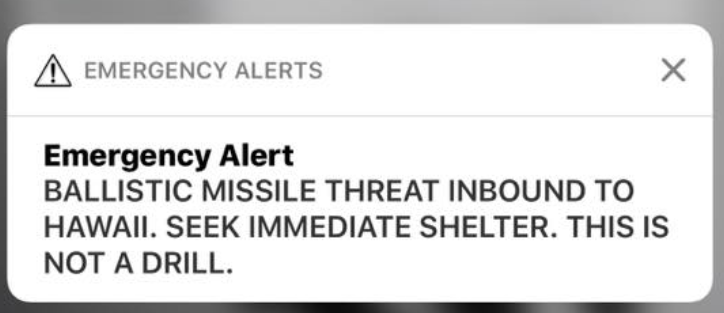 Right here is the meat of the report’s findings, which echoes the considerations many raised instantly after the alert:
With respect to insufficient safeguards, most significantly, there have been no procedures in place to forestall a single individual from mistakenly sending a missile alert to the State of Hawaii. Whereas such an alert addressed a matter of the utmost gravity, there was no requirement in place for a warning officer to double examine with a colleague or get signoff from a supervisor earlier than sending such an alert.
It is usually troubling that Hawaii’s alert origination software program didn't differentiate between the testing atmosphere and the dwell alert manufacturing atmosphere. Hawaii’s alert origination software program allowed customers to ship each dwell alerts and take a look at alerts utilizing the identical interface, and the identical log-in credentials, after clicking a button that merely confirmed “Are you certain you wish to ship this alert?” In different phrases, the affirmation immediate contained the identical language, no matter whether or not the message was a take a look at or an precise alert.
…Widespread business follow is to host the dwell alert manufacturing atmosphere on a separate, user-selectable area on the log-in display screen, or by a separate software. Different alert origination software program additionally seems to offer clear visible cues that distinguish the take a look at atmosphere from the dwell manufacturing atmosphere, together with using watermarks, coloration coding, and distinctive numbering.
The Hawaii Emergency Administration Company had not anticipated the opportunity of issuing a false alert and, as such, had didn't develop customary procedures for its response. It first despatched out a correction utilizing social media, somewhat than the identical alerting programs that it used to transmit the false alert. Certainly, the company was not instantly ready to concern a correction utilizing these programs. The company additionally didn't keep redundant and efficient means to speak with key stakeholders throughout emergencies.
Thankfully each the FCC and Hawaiian authorities are wanting into it, and have already taken the next steps:
It has created a brand new coverage that supervisors should obtain advance discover of all future drills. It's going to require two credentialed warning officers to register and validate the transmission of each alert and take a look at. It has created a false alert correction template for Emergency Alert System and Wi-fi Emergency Alert system messages in order that warning officers are extra readily ready to right a false alert, ought to one ever happen once more. It has requested that its alert origination software program vendor combine enhancements into the following iteration of its software program to extra clearly delineate the take a look at atmosphere from the dwell manufacturing atmosphere, serving to to safeguard towards false alerts.
Hawaiians can most likely really feel a bit safer, however after all the massive drawback is that any of this was potential within the first place with a system of such significance.
Featured Picture: Mark Van Scyoc/Shutterstock